
Jim Peyton : From Script to Game
JIM PEYTON: Design and bio from design
We started with the character bio from Matt Sophos and Rich Gaubert. He was to be an every man, not a typical video game hero. Jim was former military who left his career after he was injured. He switched careers to mining/terraforming. Jim has a predessor to the vital suits of the Lost Planet series that is used for mining. He does this to support his wife and baby boy. He has taken a contract job on EDN3 despite the hazards and distance to give his family a chance at making it in a collapsing global economy.
Since this is a prequel to the Lost Planet series, Jim needed a prototype harmonizer built into it to provide the fiction of staying warm on an ice planet. Jim also had to look sympathetic and kind, but tough. Dan Cabuco, art director, wanted to explore a style of future tech that looked older, similar to the hard edged tech of Star Wars.
The background concept above by uber talented Brian Yam to establish a feel and visual identity. Concepts for Jim below by the amazing Kevin Chen.

Another refinement

Below is a head study sheet with inspiration and the final concepts we developed.
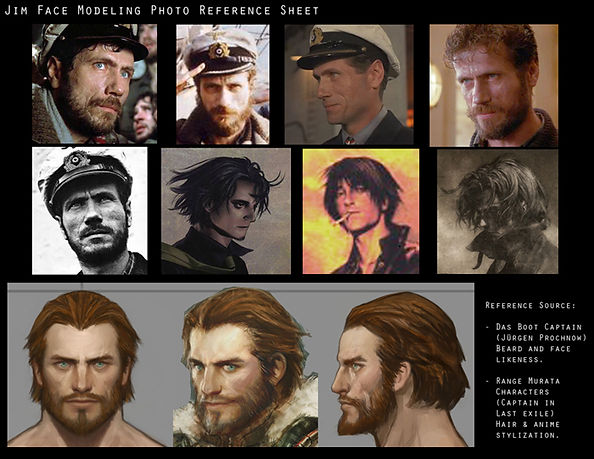

Final concept by the incredible Kevin Chen above.
Cosmonauts, miners, deepsea divers, and WW2 weaponry all went into the look and feel of Jim's suit and weapons.

Round one of modeling in pre-production. At this time our plan was to model everything by hand to capture a stylized face.

We hand-scultped a set of facial shapes based on the "Stop Staring" set up. After looking at our tests, we felt we were getting deep into the uncanny valley. We had wanted to stylize the characters but ended up being closer to realism.
Below is a range of motion test.
After looking at the results from Avatar, we decided to explore a digital double set up for our faces. We would capture body and face performance at the same time. John Root was hired to get our pipeline in place and was brilliant. He spearheaded the effort to get our digital doubles up and running. The first step was casting. Bill Watterson had done Jim's voice for us in preproduction. We went through a lot of auditions to cast a digital double for Jim and ended up going with Bill. He was an amazing "Jim" vocally. We had reservations about whether or not his distinctive features would lend themselves to a leading man role. After looking at some of his film and commercial work, we decided that he had a look that we felt would work.

After casting Bill, we got bids from several different scanning facilities and priced scanners to buy. We ended up using a facility close to our studio for easy access. Below are not Bill's scans but some test scans. We used a tweaked set of the FACS system and ended up producing around 80 muscle-based controls for our facial animation rig.
We developed several custom tools to help with our process.
Our engineering staff made us a custom shader in Unreal to drive normal maps with the mesh deformation in our cinematic scenes.
John Root wrote an awesome tool in Photoshop to blend our detail normal map and our wrinkle maps. for each character. We decided that using animating normals in actual gameplay didn't warrant the memory cost as you could seldom see the face in a static place while emoting.

Once we got the scans in, we had to do a few different passes on the textures to get Bill to become Jim. We used a lot of tricks from traditional make-up artists to make Bill's features soften into what we wanted for Jim. Bill has deep-set eyes that were making him feel more sinister with our in-game lighting. In film, they would blast him with a light. In a game, that would have been tough and expensive to carry around a dynamic lighting rig with the character. So we did it with "make-up". It's a funny day when all your character artists are scanning YouTube for mak-up lessons.

Here is an example of Jim in our Unreal Cinematics after all the adjustments.
Bill and Jim on the front cover!i

And the coolest thing ever. . .ACTION FIGURE!
